Automotive manufacturing is becoming increasingly automated, connected, and precision-driven. From body assembly and welding to component handling and final inspection, every production stage depends on accurate information. A small positioning error or missed component can lead to rework, production delays, material waste, and quality problems.
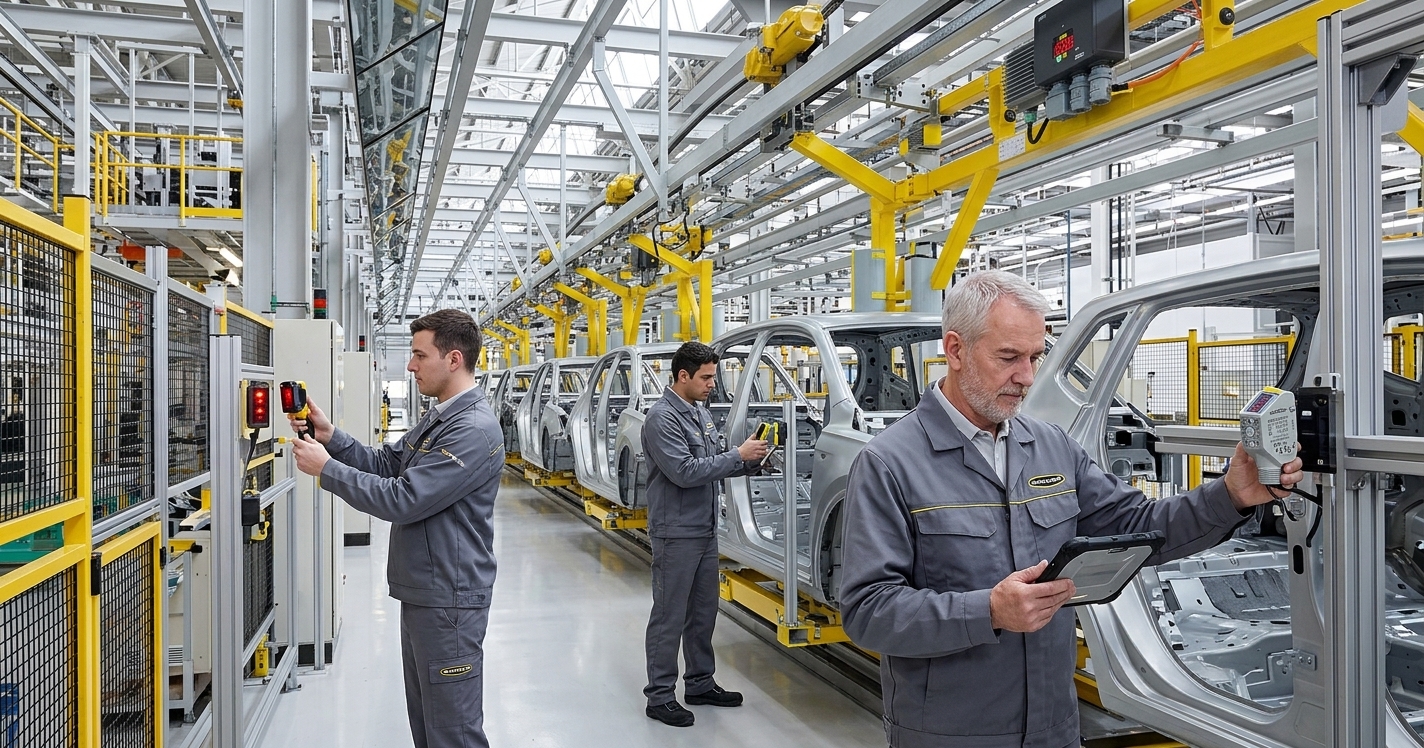
Industrial sensors have become an essential part of modern automotive assembly lines. By continuously detecting the presence, position, distance, movement, temperature, and condition of components, sensors give machines the real-time feedback they need to perform accurately and consistently.
Automation for Automotive Production
Every automated operation needs to know what is happening on the production floor. Before a robotic arm performs an assembly task, for example, the system must confirm that the correct component is present and positioned properly. Industrial sensors provide this information quickly and consistently.
Keeping Every Part on Track
Proximity, photoelectric, inductive, capacitive, and position sensors can be integrated into different stages of automotive production. Their ability to provide continuous feedback helps manufacturers maintain accuracy even during high-speed, repetitive operations.
Detect components and confirm part presence
Monitor position, distance, and alignment
Support accurate robotic movements
Reduce errors before they affect downstream processes
Better Detection, Better Automotive Quality
Quality begins long before the final inspection stage. If a component is incorrectly positioned or missing during assembly, the problem can continue through several production stages before being discovered. Sensor-based detection helps identify such issues earlier, allowing the production system to respond before they become larger quality problems.
In automotive manufacturing, this is particularly valuable for high-volume production where thousands of components may be processed every day. Consistent sensing helps maintain repeatable operations and supports a more controlled manufacturing environment.
Supporting Automated Quality Control
Industrial sensors can also work alongside machine vision and automated inspection technologies. While advanced vision systems can analyze detailed product characteristics, sensors provide essential information about component presence, positioning, movement, and process status.
Together, these technologies can help manufacturers create a more responsive quality-control process.
Identify missing or incorrectly positioned components
Support automated inspection processes
Improve production consistency
Reduce rework and unnecessary material waste
Keeping Automotive Production Moving
Modern sensors can also provide valuable process information that can be connected to PLCs, SCADA systems, industrial networks, and IIoT platforms. This allows production and maintenance teams to gain better visibility into what is happening across the factory.
With real-time sensor data, manufacturers can identify unusual conditions, respond to problems faster, and make better maintenance decisions.
From Sensors to Smart Automotive Manufacturing
The role of sensors is no longer limited to simple object detection. As automotive factories move toward smart manufacturing, sensor data is becoming an important foundation for connected and intelligent production systems.
When integrated with IIoT, robotics, AI, machine vision, and predictive maintenance, industrial sensors can help transform raw production signals into useful operational insights. Manufacturers can use this information to optimize processes, monitor equipment, improve quality, and make faster production decisions.
This creates a connected manufacturing environment where machines do more than simply operate—they can sense, communicate, and respond.
Choosing the right Brand
There is no single sensor technology suitable for every automotive application. The right choice depends on the material being detected, sensing distance, accuracy, response time, environmental conditions, installation space, and required connectivity.
For example, inductive sensors can be useful for detecting metal components, while photoelectric sensors can detect objects without physical contact. Position and distance sensing technologies can support precise movement and alignment, while vision systems can provide more detailed inspection capabilities.
Choosing the appropriate sensing technology can therefore make a significant difference in automation reliability and production quality.
Vehicle Design to EV Innovation! NGen IT delivers AI, IoT, automation, robotics, and smart manufacturing solutions for next-generation automotive production .